Royal marriages, whether for politics or love, have been an important part of Sri Lanka’s history for many years. Even though there are not many details about the ceremonies, we can learn about them from historical writings, sculptures, paintings, and stories.
In the past, Sri Lankan royals were treated almost like gods, and every important event in their lives from birth to victory in battle was celebrated in a grand way. Most royal marriages in ancient Sri Lanka were arranged to make a king stronger politically or to build relationships between kingdoms. These marriages also helped protect the royal family’s right to rule.
However, a few marriages were based on love and became famous stories, such as the union of Princess Unmada Chitra and Deegagamini, and Prince Saliya and Asokamala. No matter the reason, royal weddings were always important events and were likely celebrated in a big way.
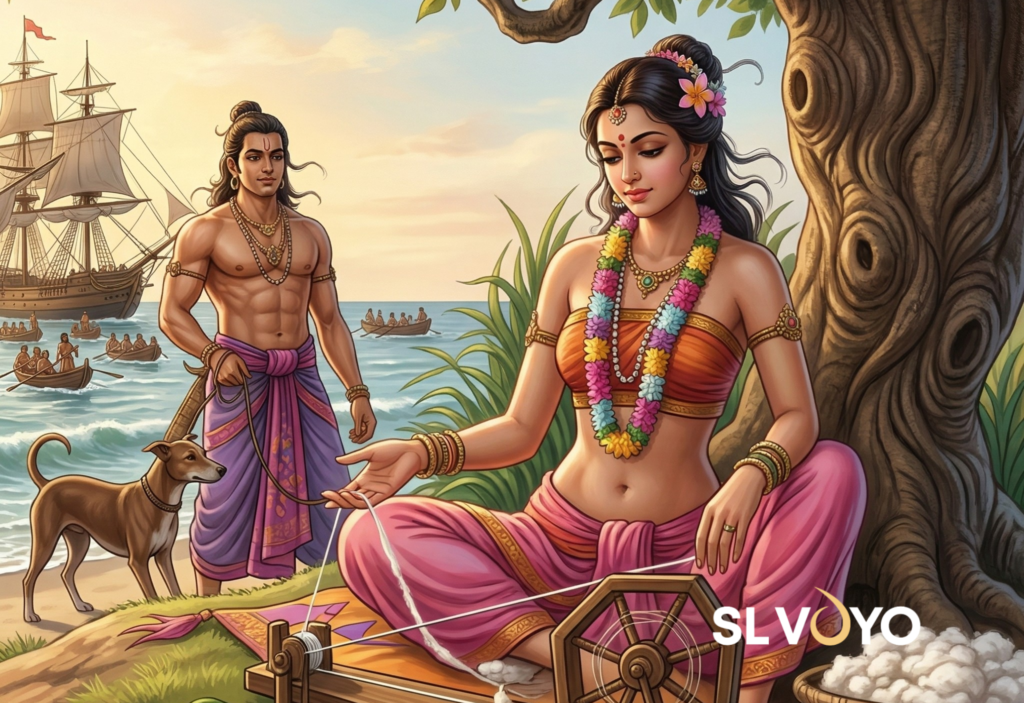
One of the earliest well-known royal couples mentioned in the Mahavamsa is Prince Vijaya and Kuweni. Their meeting was not romantic at first. Kuweni promised to help Vijaya gain a kingdom, and that led to their union. According to stories, there was a tradition among the Yaksha people to celebrate marriages with a festival lasting seven days. Although such a celebration is not mentioned for Vijaya and Kuweni, Kuweni did offer food to Vijaya and his men. She is described as a young woman wearing ornaments. Their union took place under a tree, where she prepared a bed, while his followers stayed nearby. There are no details about Vijaya’s clothing, but it is believed he wore the style of Indian royalty of that time.
During the Anuradhapura period, texts and sculptures show that royals wore a simple cloth around their waist, likely made from fine fabric. Their upper bodies were uncovered, showing their high status, and they wore heavy jewellery such as necklaces, chains, earrings, bangles, and anklets. Kings like King Dutugemunu were known for wearing rich ornaments. Men tied their long hair in a bun, while women styled their hair in elaborate buns decorated with gold and gems.
One royal marriage custom mentioned in texts is that princesses were given special gifts on their wedding day. Often, they were placed on gems as a blessing for their married life. This tradition was followed not only by the bride’s family but sometimes by others as well. For example, King Dutugemunu gifted gems to Asokamala during her wedding to Prince Saliya. In another case, King Kavantissa himself presented gems during his wedding to Princess Viharamahadevi.
The marriage of King Kavantissa and Princess Viharamahadevi is almost like a romantic story. The princess was sent to the sea to save her father’s kingdom. Her boat later reached the kingdom of Ruhuna, ruled by King Kavantissa. It is said that she was taken in a grand procession to Magul Maha Viharaya, where their wedding was held. Statues believed to represent the couple show them dressed in the style of the time—bare upper bodies covered with jewellery, decorated hairstyles, and cloth around the waist. Princess Viharamahadevi is also shown wearing a frill above her cloth.
Royal clothing changed over time. For example, Queen Samudra Devi of the Kotte Kingdom is believed to have worn detailed and elegant clothing with a special headdress, based on a 16th-century ivory statue.
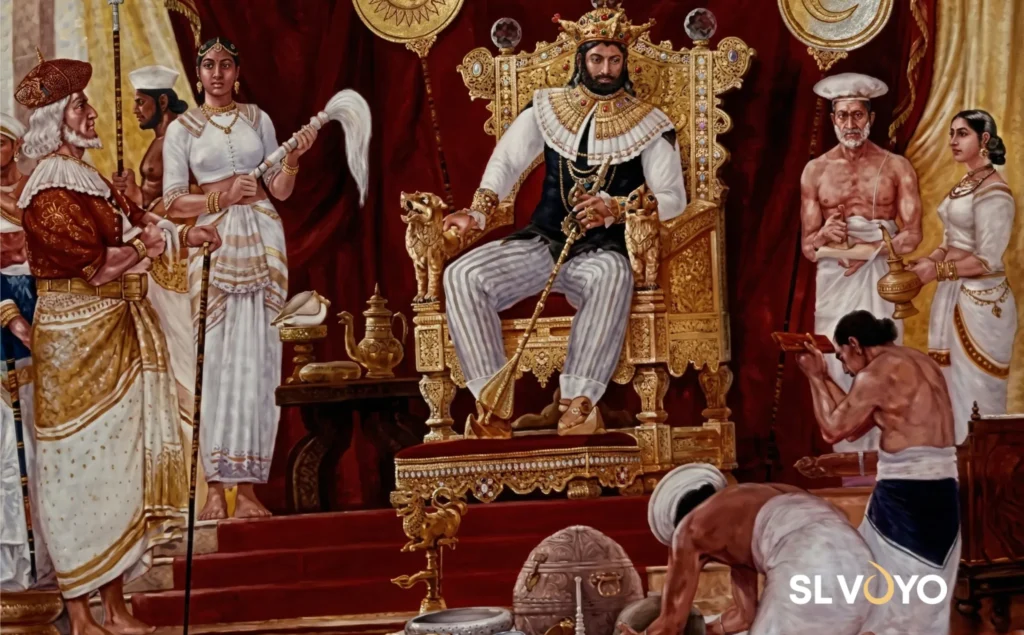
At the beginning of the Kandyan Kingdom, royal customs changed, possibly due to foreign influence. King Vimaladharmasuriya strengthened his claim to the throne by marrying Dona Cathirina (Kusumasana Devi), who had royal blood. Their wedding happened quickly, and since the queen was raised in a European style, she likely wore European clothing. This marked a change in royal fashion. The king wore a loose jacket and a cloth wrapped around his waist in a special way. Later, kings wore crowns, jewellery, and carried swords during important events. Fine fabrics like brocade became popular, especially during the time of the last Nayakka kings.
The clothing of queens in Kandy also changed with foreign influence. A portrait of Queen Rengammal, the last queen of Kandy, shows her wearing rich clothing and heavy jewellery. Her style is believed to have influenced the modern Kandyan bridal jewellery worn today. Unlike earlier times, her hair was decorated with flowers instead of gems. Although we do not have detailed descriptions of Kandyan royal weddings, it is likely that they wore similarly rich and beautiful outfits.
What is it?
Google Ranked #1, the Heartfelt Expedition is a unique tour that invites tourists to personally engage in charitable events from the perspective of a local donor. Participants will be involved in school initiatives, elderly adoption, and community assistance throughout Sri Lanka.
Discover authentic culture and make a difference by helping local communities.