It’s the all purpose movable fixture found in almost every home in Sri Lanka. It’s the tuck away bed. It’s the dining table. It’s the religious devotees’ seat to hear monks preach their Buddhist sermons. It’s also the stage of musical performances, called ‘paduru’ parties. Meet the Sri Lankan mat, the island’s ‘paduru’ of a thousand and one uses. The roll up, take it anywhere magic carpet of Sri Lanka where the nation’s forefathers dreamt their dreams upon.
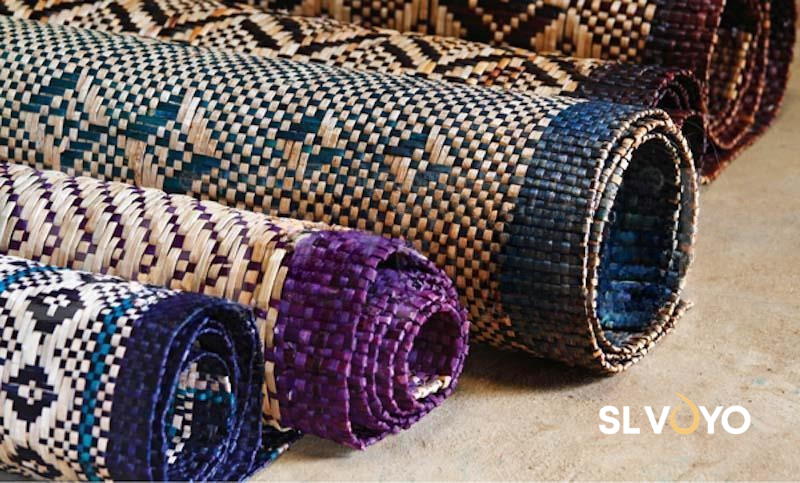
In the valleys of Dumbara, in the Kandy district, the mats are generally not handwoven but are produced on looms. It enables them to add a variety of colours into the mats.
It’s in the rivers and in the marshes of Sri Lanka that the raw material to weave mats fit for a king to sleep on are found. And often it’s the womenfolk who will search river banks and walk through the marshes to find that special reed named pan to produce the perfect mat.
There is a whole family of pan reeds to choose from. From the hawan pan, and the gal la pan, to gatapan, wetakeyya, thunhiriya and pothukola. All are ideal materials to weave a mat. But first, after it has been cut and brought home, the crop of the day must be boiled. To add value to this simple reed, it is boiled with dye to give it bright colour.
The natural dye to give it colour comes from plants. For the colour red, patangi; for yellow the venivel; for purple, katarolu and for black, bulu. After the reeds have gone through the boiling process, it is then left in the shade to dry. Then only does the art start.
The hard work of making begins when two reeds of the same length are placed together vertically, running parallel to each other like a rail track. A third is brought into the frame and placed horizontally to tie up the two. The process of weaving continues until a complete mat is made. But throughout the process, the work is often accompanied by reciting Sinhala poetry.
The pan padura is handmade. And the mental discipline needed to weave from raw river bank reeds to a functional piece of art in a mix of colours calls for inspiration. Fortunately, there is a whole segment of Sinhala kavi devoted to it. It’s called the vatti mala kavi, the four line mat chain in praise of their artistic craft and their hard work to create a single designer mat.
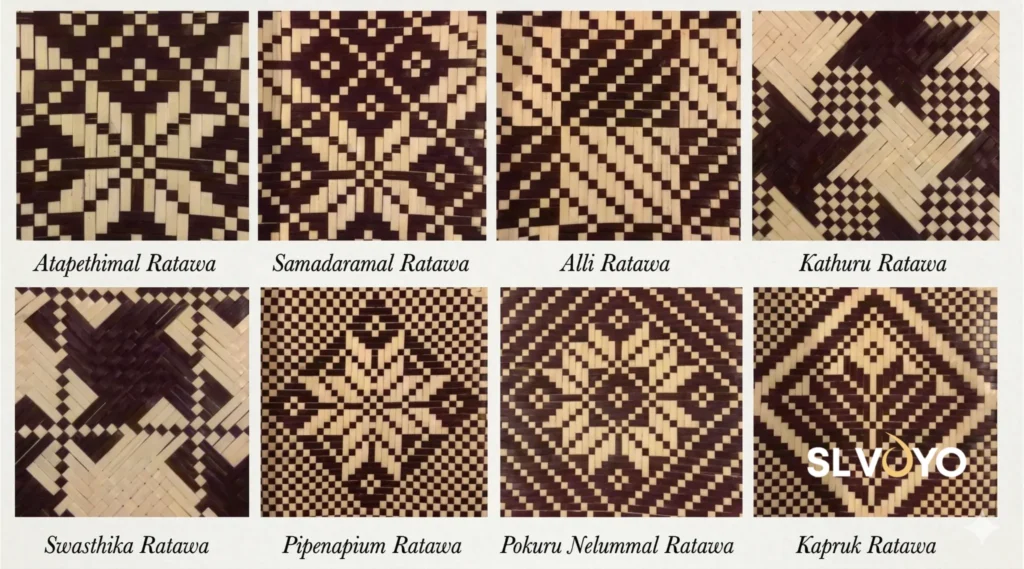
It’s not only colour that has given added value to the mat. It’s also the design, the artwork, the patterns used. The price of the padura depends on the patterns made on it. Amongst the most popular are the lotus motif followed by the Na flower. Swans intertwined in a close embrace, the tall mountains, the knotted rope and the plaited cord and the blooms of a flowering bush or tree are the others popular at present times to decorate the braided reeds of the Sri Lankan mat.
In the northern parts of the island, where mats are woven with palmyrah leaves, the strips are coloured by being soaked in boiling dyed water and then in cold water to ensure the colour stays.
However, it’s not only pan reeds that are used as the padura’s warp and woof. There’s also thal (palmyrah). The leaf of the island’s north. The leaf of the palmyrah tree. In the dry zones of the island’s north and east, these strong trees stand tall. Its long life is well known and so is its leaf. Palmyrah is also known for its cooling properties. These thal paduru are hand woven with beautiful traditional designs.
The paduru of Sri Lanka maintain its rich cultural and artistic heritage while also continuing to be an important element in every island home.
What is it?
Google Ranked #1, the Heartfelt Expedition is a unique tour that invites tourists to personally engage in charitable events from the perspective of a local donor. Participants will be involved in school initiatives, elderly adoption, and community assistance throughout Sri Lanka.
Discover authentic culture and make a difference by helping local communities.